The video, "Falsely Accused", is a news story about a woman that walked into a police station and accused her fiancé of several violent crimes. Her goal was to have him in prison. She did this without a shred of actual evidence.
The video, "FBI Hunts a Black Widow", is a recent news story about a woman conning men. Then killing them. Why did these men die? Maybe they were too embarrassed to admit that they were conned.
Malignant Narcissism
Vulnerable Presentation Comorbidity Psychopathy
Malignant narcissism is a complex and harmful form of narcissism that incorporates aspects of antisocial behavior,
sadism, and paranoia. While narcissism and psychopathy can manifest differently in women compared to men, it's
important to understand the characteristics of the female presentation.
vulnerable presentation (covert)
underlying insecurities
Despite the grandiose fantasies that are common in all narcissists, vulnerable narcissists struggle with deep-seated
insecurity, low self-esteem, and hypersensitivity to criticism or perceived slights.
introverted and shy exterior
They may present as introverted or shy, and appear emotionally fragile or even victimized in interactions.
passive-aggressive tactics
They may employ passive-aggressive behaviors like covert manipulation, guilt-tripping, or playing the victim to get
their needs met and gain sympathy or admiration.
need for validation
They have a constant need for external validation and attention to shore up their fragile sense of self.
Comorbidity with psychopathy
darker aspects
The addition of psychopathic traits with vulnerable narcissism can intensify the manipulative, exploitative, and antagonistic
aspects of their personality.
lack of empathy and remorse
The lack of empathy inherent in psychopathy will be amplified, making it even harder for them to understand or care about
the feelings or suffering from others.
cruelty and sadism
Malignant narcissists, especially those with comorbid psychopathy, may derive pleasure from causing pain and enjoy
the downfall of others. They are ego syntonic, sadistic.
manipulative guise
They may use their perceived vulnerability and emotional instability as a manipulative tool to control others and
achieve their goals. They may present as empathic and caring while using those stereotypical feminine characteristics
as a manipulative tool.
Important Considerations
diagnosis
Malignant narcissism is not a formal diagnosis in the DSM-5, but rather a descriptive term used by clinicians.
However, the individual symptoms and behaviors associated with this presentation are often diagnosed as personality
disorders like narcissistic personality disorder, antisocial personality disorder, and paranoia.
gender differences
Women with psychopathic traits may exhibit different behavioral expressions than men, often including more emotional
instability, verbal violence, and manipulation of social networks (not social media), and less criminal or instrumental violence.
difficult to identify
Vulnerable presentation can make malignant narcissism in women especially difficult to identify, as their outward
behaviors may not align with the typical image of a "narcissist."
impact on relationships
Individuals with this combination of traits can be highly destructive to personal relationships due to their manipulative tendencies, lack of empathy, and emotional instability.
It is critical to remember that this is a complex and dangerous combination of traits that can lead to the significant harm of others. If you suspect you are dealing with someone exhibiting these characteristics, seeking
professional guidance and prioritizing your own safety and well-being is important.
narcissistic sycophancy
a narcissistic sycophant
Is someone who combines narcissistic traits with sycophantic behavior. They are individuals who crave admiration and
attention (narcissism) while simultaneously engaging in excessive flattery and subservience (sycophancy) towards
someone they perceive as powerful or influential, often to gain favor or personal benefit. These individuals are prone to manipulation. They are often referred to as "flying monkeys" and "minions."
Narcissistic Supply
narcissistic supply
Is the attention, admiration, and validation provided by others. Supply is sought by individuals with narcissistic personality disorder (NPD). This supply regulates their fragile self-esteem. This external "fuel" is essential for them to maintain a grandiose "false self" and mask deep-rooted feelings of emptiness and shame. The need for supply is often insatiable, as no amount of external praise, is ever enough to fill their inner void. It is an addiction.
In the case of the malignant narcissist supply can also be derived from emotional abuse, psychological torture of others, and causing loss to others. The victim is usually someone they have consistent contact with. This can be a partner, child, parent, or other relative. When they are deprived of it, they may feel anxious, irritable, and ashamed, sometimes leading to narcissistic injury and rage.
aggression and devaluation
A narcissist may put down a romantic partner or subordinate to feel better about themselves and make the other person
more dependent.
Provoking reactions: They create drama or arguments to elicit strong emotional responses, which reassures them of
their own importance.
Intimidation and control: Narcissists use abusive tactics to dominate others and maintain a power imbalance in the
relationship.
ingratiation and manipulation
At the beginning of a relationship, narcissists often use "love-bombing" to shower a new source with excessive praise
and attention.
Manipulation and exploitation: They may befriend vulnerable or dependent people so they can be seen as a "hero" or
"savior."
Image management: They use bragging, seduction, or feigned affection to gain admiration.
other sources of supply
This can include casual acquaintances, colleagues, and even strangers who offer small amounts of attention.
material supply sources
Acquiring expensive items like cars, homes, and designer clothes helps reinforce their sense of superiority. Status and recognition: Achievements, awards, and association with influential people feed their ego and self-importance.
Social media: Likes, followers, and comments provide a continuous, accessible flow of validation.
Financial gain: Success achieved through any means, ethical or unethical, serves as a source of power and affirmation.
narcissistic supply cycle
The narcissistic supply cycle often follows a predictable pattern in relationships with a primary source.
Idealization: The narcissist showers a new person with attention, praise, and charm, making them feel like the most
important person in the world.
Devaluation: Once the initial validation wears off, the narcissist begins to criticize, manipulate, and emotionally
abuse the person.
Discard: When the narcissist has depleted the source's usefulness or found a new source, they abandon and cut off the
old one.
Hoovering: In some cases, the narcissist may return to the discarded source if their new supply runs low, attempting
to draw them back in with promises of change.
Description of Her.
PPO has nine-years of experience, and counting, with Ms. Magnusson doing things to him that he refuses to speak about.
What is being made public on this site are some of those experiences, not all. The physical scars are there, for sure.
The psychological and emotional damage are evident if and when he chooses to talk about those experiences. There doesn't
seem to be hyperbole in his description of her, or the things he has been through since knowing her. It isn't bias is
his descriptions, but an overwhelming saturation of experience with her.
This is her, according to him... What is real. She has a master's in adult education, she is a highly skilled, and was
an accredited asl interpreter. She is well-read, with more than an
above-average intelligence. Her knowledge of vegetables and the sort of information is better than others. She doesn't
wear makeup often, doesn't wear expensive clothes, in the past her clothing wasn't form fitting; this has changed from
putting on weight. She doesn't smoke, tends to be participating in quirky hobbies, usually for a reason. Despite her
outward effect, she exudes sexuality without even trying. Some men get it, others don't. She is frugal for the most
part. Doesn't have a use for a large home, or any of the other things that motivate other people. She will spend
obscene amounts of time, energy, and money on pursuits directed at causing another irreparable harm.
What is not true... Ms. Magnusson has a fair amount of cookbooks, blenders, mixers, and cookware in her kitchen. Does
this mean she can prepare a good meal that is above the normal fare? She is articulate, and knows key phrases to put
out there. However, she can do know more than fry a steak in a pan. When she decides to bake something, she makes a
big production of it. This includes, changing the amount of the key ingredients, without adjusting the amounts of the
other ingredients to balance it out. She will make a loaf of bread here and there. Her gardening skills are nothing to
admire; average. She likes to make announcements concerning the vegetables she has planted at a small community garden.
If given the opportunity, she will be sure to criticize others that have vegetables growing there. She is not as
knowledgeable in several languages she claims to be knowledgeable about. Her claim to speak conversational German is
not true. When asked to order off of a Spanish menu, she could not do so. This is a repeating pattern.
She promotes herself as a violin teacher on Facebook. She claims to have thirty years of music experience. In person,
she often rattles on about obscure pieces of music that most people will have no knowledge of. She chose obscure and
classical music to appear knowledgeable and capable of playing because it prevents the rebuttals, and questions that
may be asked. Thus proving she has only a smattering of musical ability. What makes it obvious she can barely play any
music is her claim of thirty years experience. In that amount of times she should be able to play quite a bit of well
known music from memory. Happy Birthday for example. The little bit of music she can play from site is flat, and lacks
any emotional quality. What she does know is music terminology, what each note is, and how to read music. She has
fashioned opinions about various musical subjects from the opinions of others. The term for all of this pretending is
the dunning-kruger effect. She knows just enough to pass herself off as
knowledgeable, or even as an expert, to the lay person. This includes the students,and parents of students.
Her presence on social media is carefully crafted to reflect her character as that of a good person. She will list her
hobbies, and other benign information. She associates herself with various pro-diversity pages, and a smattering of
volunteering at various nonprofits is noted by her as well. The volunteering is done under the guise of teaching her
daughter about being a good person, she believes this makes her a good parent by default. What she does not mention
is that she lost it all in the divorce, including parental custody. She pays child support, and the other expected
expenses of a noncustodial parent. Which she despises. She has over-the-top responses to other peoples personal
tragedies by sharing her experiences of the same. These are a version of stolen valor, which can be easily vetted.
PPO has told of Ms. Magnusson's never ending character assault of her daughter's friend. Constantly referring to him as
dumb, stupid, and a wide variety of phrases that insinuate he is clumsy because he has a low IQ, etc. Yet, she had no
problem with leaving her daughter for a sleep-over with him. This is so she could go get high, and participate in PnP.
Sophia is her older sister by four years. According to PPO, it is a wonder Ms. Magnusson even communicates with her.
It is a constant barrage of how inept her sister is. She is incapable of so many things. This includes her ability to
parent her child. Sophia had her parental rights terminated by a judge when the child was young. Why is not known. Ms.
Magnusson has no problem mentioning this, without divulging the reason for this loss of parental rights.
Thea Felice Magnusson is a malignant narcissistic psychopath. She has all the grandiosity of a male narcissist; however,
it is manifested through her daughter. According to Ms. Magnusson, her teachers are continually holding her back, which
means she is smarter than her teachers. Ms. Magnusson is constantly reminding others of her daughter's intellectual
ability, and its emergence at an early age, etc. All of this information is offered as the proud, yet humble parent.
Her narcissism is malignant and presents itself as vulnerable (covert). After nine years PPO is confident stating she
actively derives pleasure from the pain of others. Because she is a vulnerable narcissist, even a minimal slight can
cause her to go into a narcissistic rage of vindictiveness. She is naturally ego-syntonic sadistic, despite the persona she presents for others to see.
If she believes that you have caused her harm, this can be from her own mind, she will be proactive, in the destruction
of her target. This will be in every facet of their life. Professionally, emotionally, and psychologically. Should the
opportunity to physically attack another present itself, she will not let it go by. She is a master manipulator, an
expert at psychological torture, and emotional abuse in such a manner to cause permanent damage.
Her psychopathic traits are obvious if she presents them to someone. Her lack of empathy, compassion, sympathy, or any
other real emotional capability will be apparent, except for one. She can display a seething anger or hatred, when
provoked and it is very real. She can also fake an emotional response well if needed. It is common for her to practice
the expected emotional responses when watching a movie. Otherwise, she is prone to mirroring a response. Once PPO got
to know her, the adhoc attempts at portraying an emotion were apparent.
The image below shows that she has a propensity for sexual encounters with uncles, cousins, step-brothers, and other
assorted relatives. She initiated a relationship with her newly acquired step-brother when she was fourteen, and he
was seventeen. The individual in the text exchange is Eric White. He is the son of Travis Fretter's long-time partner.
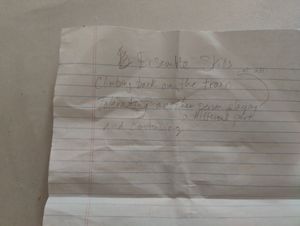
Travis being Thea Magnusson's late father. The photo of the note is written by Ms. Magnusson to herself. It says the
following: Ensemble Skills. Climbing back on the train. Tolerating another person a different part, or anything at all,
amd continuing. Ms. Magnusson has shown that she knows to keep her professional, personal, and family lives separate
from her victims. This is to prevent her victims from interacting with these people. This shows she is self-aware. The
note in the photo, lends itself to this as well. However, the note about the ensemble also shows that she believes she
is qualified to play with experienced musicians. These are people that will figure out within seconds that she is faking
her entire musical existence.
RID Violation
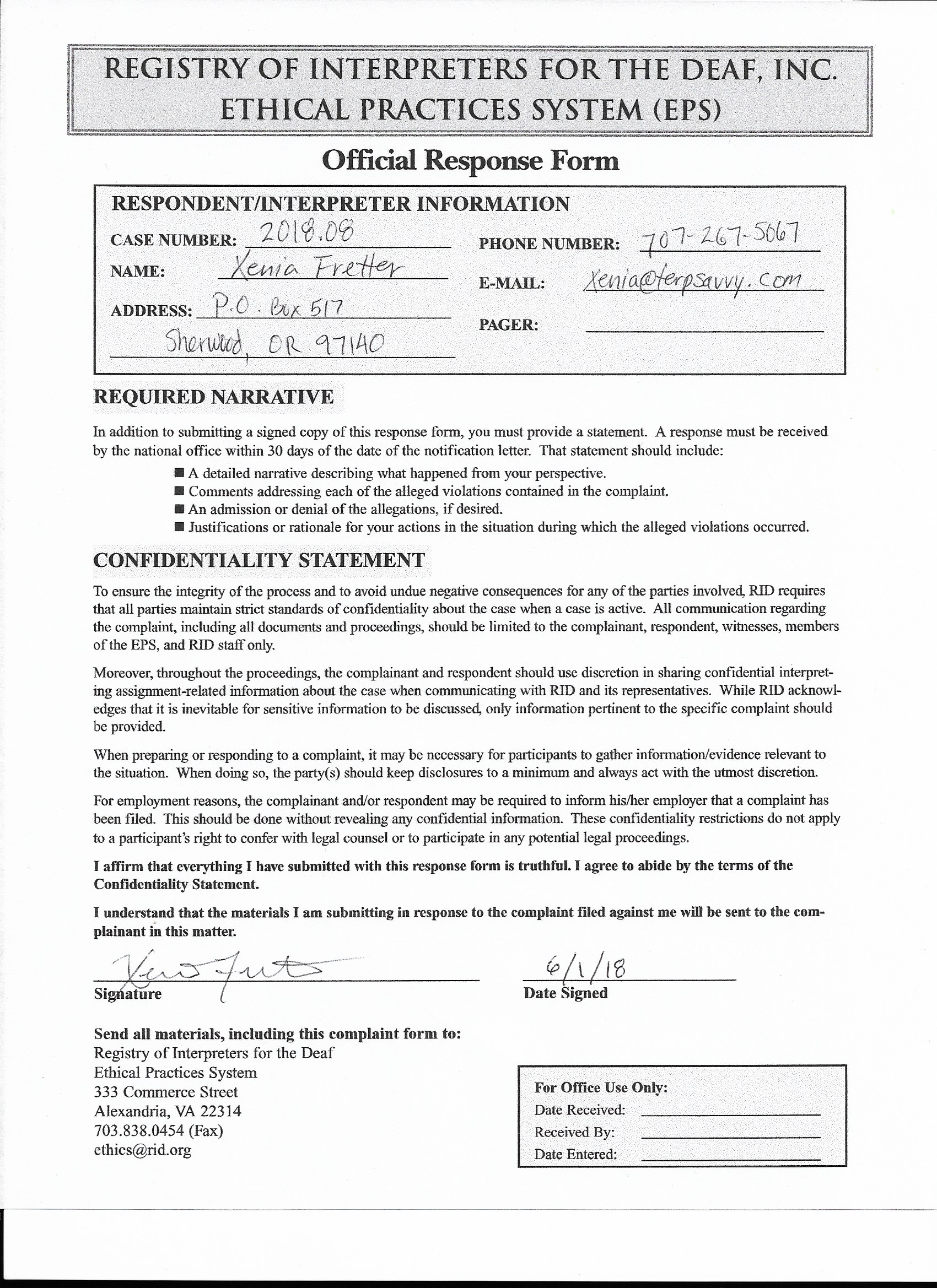
Thea Felice Magnusson, who was still Xenia Marlene Fretter, at the time of the RID violation, decided that she would
sacrifice anyone to convince PPO that she is not the person he knows her to be. He had told her he is aware of her
actions, and the never ending lies. PPO was clear in his message, she was to stay away from him. Ms. Magnusson doesn't
let any man tell her he is done with her. Nor will she let anyone accuse her of being a pathological liar and a chronic
cheater. Without a second thought, she decided to use her work assignment as a cover. The knowledge of her traveling to
Humboldt County for work would have no impact on the overall situation. She sent a photo of her work assignment to him
anyway. In the photo she had sent him were the names, date, time, and location of where she would translate for two
little girls. The two girls were the primary witnesses in a human trafficking case. This information was on a need to
know basis. There was no need for PPO to know.
The lead investigator for the case was called. They had a short conversation; PPO sent the investigator the information
requested in an encrypted email. Then he was told he should stay away from people in general for the next two days.
How do you evaluate the actions of Ms. Magnusson? Divulging information of this nature is unprofessional, unethical,
and morally repugnant. Did she give this vital information to the wrong person? No. If anything, she told the right
person.
There isn't a lot of information available from RID (Registry of Interpreters for the Deaf). RID was unwilling to
communicate regarding the final decision related to Ms Magnusson. Fortunately, RID is not the only source of information
on this matter. This can be seen in the photos below The outcome of Ms. Magnusson's hearing was a fairly mundane punishment
for what she had done. What should have sealed her fate (in my opinion) was the discovery RID made while discussing
Ms. Magnusson's repulsive behavior. RID's governing body discovered that Ms. Magnusson is an
intravenous drug user, with a serious addiction. Even with that
added on, she got a slap on the wrist. A three-month suspension, fifteen hours of mentoring, a self-reflection and
assessment report, and an affidavit stating she would follow the rules. The entire matter would have been wrapped up
in ninety days.
Ms. Magnusson chose to end her career instead of accepting the punishment. She could have gone on sabbatical and ignored
any rumors afterward. This would have been forgotten. RID did not want one of their star interpreters being in the
spotlight. This would have been a public relations nightmare if this were to have become public knowledge. In Ms.
Magnusson's narcissistic mind, PPO was the one responsible for her career ending. She has been making him pay ever since.
Her Aliases
Thea Magnusson uses Sophie as an alias when she is making drug deals. Basically any time she is committing a crime
or hooking up with strangers. Sophia is her older sister's name. This is Ms. Magnusson's way of insulting her older
sister. According to PPO, Ms. Magnusson has no love for her sister. In the time he has known her, she has continuously
insulted, degraded, and put down her sister in almost anyway possible. A constant stream of hate. Ms. Magnusson
despises being the younger sister.
When PPO met her on Okay Cupid, the username she used was "Sonya Halpern(an Atlanta Socialite." Which she continued to
use initially. This is understandable. However, she kept insisting that PPO use Sonya, despite knowing her real name.
PPO told her, "It is strange that you would insist that I call you Sonya, even though I know your real name." PPO
always used her real name. However, wg was easily
convinced to call her Sonja, with a "J." Why? This made it special for him. WG was an easy mark.
About the author
This entire project started with a mundane transaction. I purchased a pair of sunglasses from a guy on Facebook Market Place. Before leaving, I asked if he had anything else to sell. He gave me a quick rundown of an inventory of smartphones and digital storage devices he was looking to liquidate.
Before he would hand over the devices, he stopped and gave me a remarkably intense, dead-serious warning. By the time he finished explaining the history attached to the primary smartphone, I was entirely convinced he was full of it. I assumed it was classic hyperbole. A bitter, resentful ex-boyfriend who was angry because his former partner had gotten the better of him. The concept of a non-stop, relentless, multi-year campaign to systematically destroy a person's life on every single level sounded entirely absurd. Then, he laid down the bet.
The Two-week wager
He gave me a list of things to expect and a list of things that shouldn't be happening on a modern smartphone. I also agreed to take one of the external hard drives with me. Here's the wager... He wouldn't wipe the phone, and I had to seriously look through the hard drive. Two weeks was the time limit we agreed on. If I came back within the two weeks and was not convinced, the phone was completely accessible to someone else. That the data on the
drive did not appear alarming in any way. He would give me back the money, and I could keep the phone and drive.
To win this bet, and pocket the cash, I had to make an appearance in two weeks. I was back in five days. I had questions about the information in the drive and in the phone. The phone produced almost every behavior he warned me about. This could have been him doing this. Considering the wager, what would be the point.
I wanted to know the correlations between the drive contents and the real world events he claimed had occurred. If this was a massive fabrication, what could he possibly gain from it. Too much time may have passed for him to press any charges. He has spent a lot of time in jail. This was easy to confirm. What he did have is enough
circumstantial evidence to cause me to think. The more I saw, the more I understood that I couldn't say it was not true.
How much of what he said was bias-based? For nine years, his focus had been on his situation. I asked questions and he answered some of them. Others were not answered. He was buried in shame and embarrassment; this was clear. After a while, I realized there was damage I couldn't understand. He had shown me some of the physical scars. He told me about other scars he didn't want anyone to see. He told me how she gave them to him. The problem is
believing how he got them.
I began going through the drives one at a time. There was no order to them. Correlations began to take
shape. Patterns of behavior started to appear. I combined the little events with the big events that are easily fact-checked. So far, it was possible some of the events may have occurred. I have no life experience with something like this. I did not see how someone could fabricate all of this?
Psychology Terms
darvo (deny, attack, reverse victim and offender)
Is a reaction that perpetrators of wrongdoing, may display in response to being held accountable for their behavior.
This is a common manipulation strategy of psychological abusers.
dunning-kruger effect or false expertise
When a narcissist learns just enough about a topic to sound like an expert, this behavior is known as intellectual
superficiality or a smattering of knowledge. They use this shallow knowledge to manipulate others, protect their
fragile ego, and demand control in conversations. Key behaviors are loud confidence, name-dropping, shutting down
debates, and stealing credit.
hyperactive agency detection (monomania)
An evolutionary cognitive bias that causes humans to assume events or ambiguous stimuli are caused by intentional,
thinking agents. When this natural survival mechanism becomes an overwhelming, all consuming mental focus akin to a
monomania. It leads individuals to perceive hidden plots, spirits, or conscious intent behind every random occurrence.
de clérambault’s syndrome variant(erotomania)
A rare mental health condition characterized by a fixed, false belief that another person—often a celebrity, public
figure, or someone of higher social status—is deeply in love with the affected individual.
malignant narcissistic discard reaction
Is an abrupt, cold, and malicious termination of a relationship where the abuser treats the partner like disposable
trash. Because malignant narcissists combine grandiosity with sadistic and paranoid traits, their reaction during a
discard is intensely vindictive, aimed at destroying the target’s reputation, psychological and emotional stability.
externalization of blame via scapegoating
Externalization of blame via scapegoating is a psychological and social defense mechanism where an individual or group
unfairly shifts responsibility, guilt, or accountability for negative outcomes, failures, or systemic crises onto a
specific, vulnerable target. This process protects the perpetrator's self-image and masks deeper systemic issues.
narcissistic injury
The injury or cause can be a threat (real or imagined), criticism, broken boundary, or failure that punctures the
individual’s grandiose self-image and exposes deep-seated shame.
narcissistic rage(the revenge arc)
The rage or effect is a disproportionate, hostile reaction designed to eliminate the threat and force the environment
back into alignment with the false self. The revenge is the behavioral manifestation of the rage. This can be hot and
explosive (shouting, attacking) or cold and calculated (smear campaigns, long-term sabotage).
psychopathic splitting
Splitting is the mental breakdown of complex reality into rigid, polarized opposites. People are seen with a black and
white view, as totally heroic or completely evil, with no middle ground. An individual can have rapid shifts, switching
from idealizing someone to utterly devaluing them over a minor slight. Splitting protects the fragile, grandiose
self-image from feeling mixed emotions like guilt, ambivalence, or anxiety.
projective identification
Projective identification goes a step further than standard projection. It is an interpersonal loop where internal
distress is forced onto someone else. Unconscious, intolerable feelings (like rage, weakness, or guilt) are assigned
to another person. The person with psychopathic traits subtly coerces, baits, and manipulates the target into feeling and expressing those exact projected emotions. Once the target reacts, the manipulator uses that reaction to
justify their own stance, maintaining a sense of omnipotent control and moral superiority.
othello syndrome (delusional jealousy)
In William Shakespeare’s play Othello, a brave general, is manipulated by his assistant, into believing his innocent
wife, Desdemona, is having an affair. Othello lacks any real proof but becomes utterly consumed by irrational, toxic
jealousy. Delusional jealousy is a psychiatric condition where a person has a fixed, false belief that their romantic
partner is unfaithful. It occurs without real proof, driving extreme behaviors like constant spying, interrogation,
and potential violence. It links to brain disorders, substance abuse, or mental illness.
Legal Terms
paranoid stalking
Involves a repeated pattern of unwanted, intrusive behavior driven by persecutory beliefs, intense suspicion, or mental
health conditions. It can describe a situation where a person experiencing severe paranoia or delusions targets someone
else, or a distressing lived experience where an individual feels intensely monitored, followed, or targeted by others.
proxy harassment as an extension of power
This is a strategic extension of power where an aggressor uses third parties, institutions, or intermediaries to
manipulate, monitor, or punish a target. By acting through proxies, the primary instigator maintains plausible
deniability while inflicting profound social, psychological, and institutional harm. Aggressors manipulate friends,
family members, or colleagues (sycophants) into delivering messages, gathering intelligence, or confronting the target
under the guise of concern. Abusers file false reports with police, child protective services, or regulatory bodies,
forcing the target to defend themselves against systemic power. By turning mutual networks against the victim, the
instigator distorts the narrative, making the target appear unstable while systematically destroying their support
systems. Because the primary actor does not directly break rules or make threats, they can claim neutrality or
victimhood if confronted.
proximate stalking (geographic intimidation)
The stalker, or proxy, intentionally frequents the victim’s immediate physical surroundings, such as their workplace,
home, or favorite grocery store.
false association (misidentification harassment)
False association and misidentification harassment occur when an individual or group is wrongfully linked to a crime,
bad behavior, or an offensive public incident, leading to targeted harassment, doxxing, or reputation damage. This
often happens due to online misinformation, lookalike mix-ups, or malicious targeting. Legally and behaviorally, this
is a targeted harassment campaign based entirely on a spurious relationship (a mathematical or logical term for two
things that appear connected but have no causal link).
Freyd, Jennifer J. (February 1997). "II. Violations of Power, Adaptive Blindness and Betrayal Trauma Theory" (PDF).
Feminism & Psychology. 7 (1): 22–32. doi:10.1177/0959353597071004. S2CID 143672491. Archived (PDF) from the original
on May 1, 2020. Retrieved January 14, 2020.
https://dynamic.uoregon.edu/jjf/articles/freyd97r.pdf
Kries, Mette K. F. & Cooke, David J. (2012). The Comprehensive Assessment of Psychopathic Personality (CAPP):
Content Validation Using Prototypical Analysis.
Journal of Personality Disorders, 26(3), 402-413.
https://guilfordjournals.com/doi/10.1521/pedi.2012.26.3.402
Albrecht, B., Spivak, B., Daffern, M., & McEwan, T. E. (2022). The Temporal Relationship Between Mental Health
Service use and Stalking Perpetration.
Australian and New Zealand Journal of Psychiatry, 56(12), 1642-1652
https://doi.org/10.1177/00048674211072449
McEwan, T.E. & Strand, S. (2013). The Role of Psychopathology in Stalking by Adult Strangers and Acquaintances.
Australian and New Zealand Journal of Psychiatry, 47, 546-555
Nijdam-Jones, A., Rosenfeld, B., Gerbrandij, J., Quick, E., & Galietta, M. (2018).Psychopathology of Stalking
Offenders: Examining the Clinical, Demographic, and Stalking Characteristics of a Community-Based Sample.
Criminal Justice and Behavior, 45, 712-741.
https://doi.org/10.1177/0093854818760643
Nova Southeastern University, Florida. Understanding the Psychopath from a Psychodynamic Perspective: A Rorschach Study.
Archives of Assessment Psychology
https://nsuworks.nova.edu/psyassessment/
.png)